
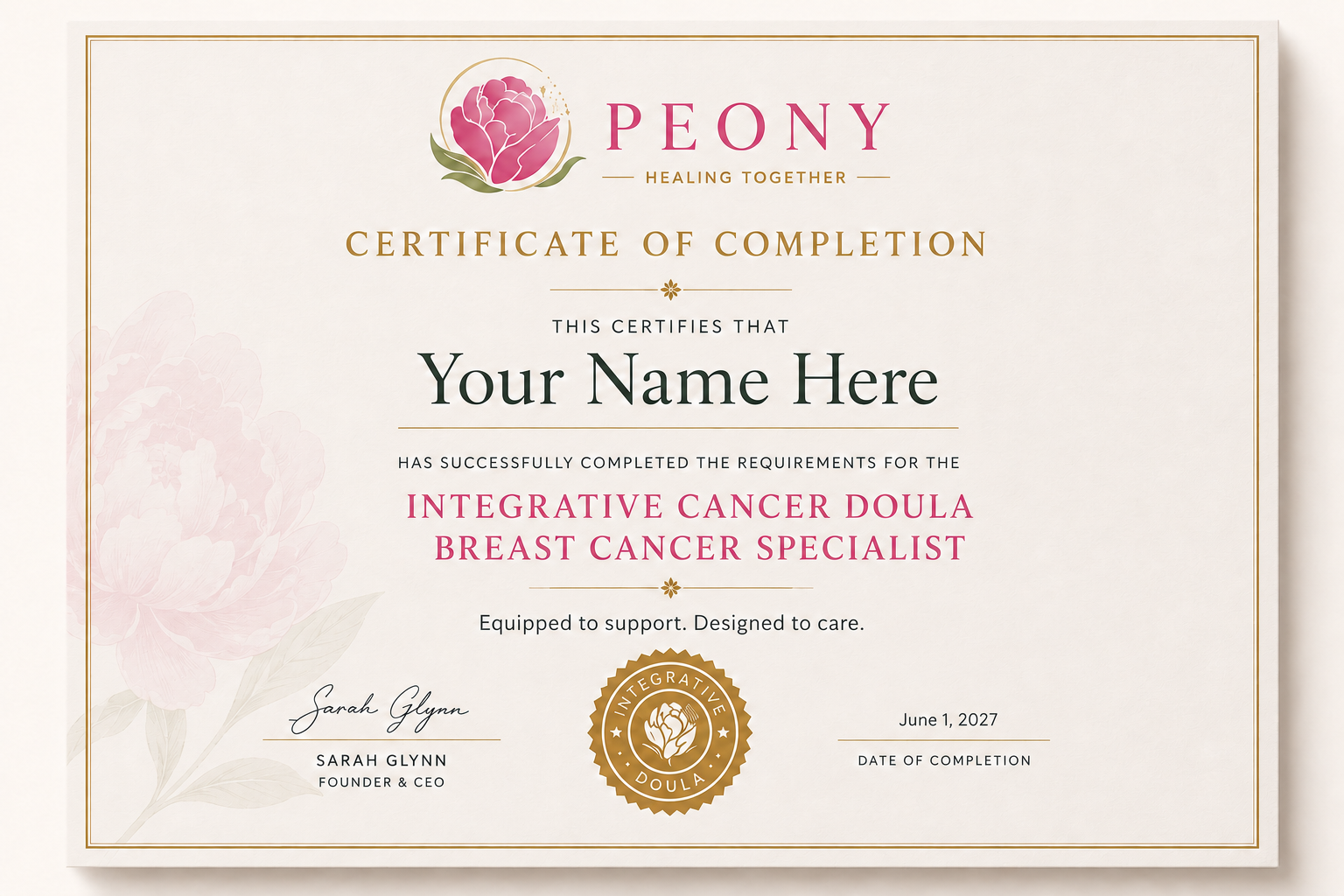
THE PEONY CANCER COMPANION CERTIFICATE
Breast cancer is lived continuously. Care is delivered in episodes.
The space between appointments belongs to no one. The Cancer Companion™ is a trained, non-clinical professional built for that space — extending continuity, facilitating the person's own care plan, and complementing the oncology team without ever replacing it.
Enrollment open · Founding cohort begins January 11, 2027 · Requires Peony PRO membership
WHY THIS ROLE
The problem isn't a shortage of caring people.
Between encounters, a person makes decisions, coordinates specialties, manages side effects, prepares for consultations, and tries to keep their own priorities visible through months of change.
That work is essential, yet it belongs to no consistently defined role.
Support already exists, but it is uneven and often unstandardized. The Cancer Companion™ is designed as a defined, non-clinical role with a shared method, clear scope, competency standard, assessment of readiness, and ethical framework.
The need is growing as oncology visits remain constrained and the medical, practical, financial, logistical, and emotional demands of treatment become harder for one person — or one clinical role — to hold.
THE ROLE
What a Cancer Companion™ does
A trained, non-clinical navigator who supports continuity, care planning, self-advocacy, and coordination through the Peony Care Plan™.
Within scope, a Companion:
- Conducts non-clinical whole-person discovery and structured identification of navigation and support needs
- Facilitates the person in creating and maintaining their own Peony Care Plan™
- Provides general, evidence-informed navigation education using approved resources
- Supports self-advocacy and shared decision-making
- Coordinates non-clinical resources and follow-through across providers and services
- Prepares the person for clinical encounters and supports them afterward
- Documents navigation and coordination in the appropriate record
- Escalates clinical concerns or psychosocial crises to the appropriate licensed professional
A Companion never:
- Diagnoses, or interprets tests, imaging, pathology, staging, or genomic results
- Recommends, prescribes, adjusts, or discourages treatments, medications, supplements, diets, or therapies
- Evaluates whether an intervention is appropriate or safe for an individual
- Delivers clinical or psychotherapeutic treatment
- Creates, owns, directs, or overrules the person's Care Plan
- Clinically triages or determines the medical severity of symptoms
- Represents themselves as licensed, board-certified, or authorized to bill on the basis of this certificate
The governing principle: the Care Plan belongs to the person. The Companion facilitates — never creating, prescribing, owning, or overruling it.
This is the shape of a new role, not a limit on an existing one. Many Companions also hold a clinical license and continue practising exactly as they did; the Companion role is something they add.
HOW THE ROLE FITS
Complement, not substitute.
The role follows strict non-duplication: one activity, one owner, one time entry.
| Role | Typical primary focus | How the Companion differs |
|---|---|---|
| Nurse navigator | Clinical navigation and triage | Non-clinical; extends continuity between encounters without triage |
| Oncology social worker | Licensed psychosocial assessment and crisis intervention | Supports and refers rather than assesses or intervenes |
| Health coach | Behavior change | Whole-person navigation across the continuum, not behavior change alone |
| Patient advocate | Advocacy; sometimes billing or insurance | Structured navigation through a single method, within a defined non-clinical scope |
| Community health worker | Community-based access and navigation | Breast-cancer-specialized, across the full continuum |
Complementarity is what makes the role integrable. It fills the continuous, between-encounter space no existing role is designed to hold.
TWO PRACTICE PATHWAYS
Where Companions work
Pathway A — Within a clinical partner
The partner determines eligibility, supervises, owns documentation, and submits any claim. Where a partner engages a Companion as auxiliary personnel, the scope of the work aligns with CMS Principal Illness Navigation services.
Pathway B — Private, fee-based
Navigation offered directly to people who choose to pay. Generates no third-party claim.
On Principal Illness Navigation, plainly: PIN alignment describes the shape of the work and the conditions under which a billing practice may engage a Companion as auxiliary personnel. It is not a credential, does not authorize billing, and does not alter scope. Under CMS rules, PIN services are furnished incident to a billing practitioner under general supervision — the navigator never bills directly. Billing determinations rest with the billing practitioner and their organization.
We state this precisely because the alternative — implying you can bill Medicare on the strength of a certificate — would not be true.
THE PROGRAM
Competency-based, not time-based.
Approximately 200 learner hours across about eight months — roughly 5–6 hours per week. Learners progress by demonstrating what they can do, not by time served.
| Component | Commitment |
|---|---|
| Orientation (prerequisite, included with PRO membership) | ~4 hours |
| Modules 1–3 — Base core | 60 learner hours |
| Modules 4–5 — Breast cancer specialization | 40 learner hours |
| Peony PRO Webinar Series | 12 webinars, ~18 hours, plus the Domain Mapping Artifact |
| Module 6 — Applied navigation | 20 learner hours |
| Capstone | ~50 hours over about two months |
The six modules
1 · Integrative Cancer Care and the Whole Person
"I understand what integrative cancer care is, who I am within it, and how to see the whole person — not just the diagnosis."
2 · The Peony Care Method™ and Care Plan Facilitation
"I know how to help people build, direct, and use their own Peony Care Plan."
The signature skill of the profession.
3 · Professional Practice and Regulatory Boundaries
"I know exactly where my role begins and ends, how to decide when it is not obvious, and how to work as a trusted member of a care team."
4 · Breast Cancer: Disease Foundations
"I understand the biology of breast cancer well enough to help someone understand their own diagnosis."
Subtypes, receptor status, staging, pathology-report literacy.
5 · Breast Cancer: Treatment Pathways
"I understand how breast cancer is treated well enough to help someone anticipate, prepare for, and organize their own care."
6 · Navigation in Practice
"I can hold the whole picture — the disease, the treatment, the supports, and the person — and navigate alongside them."
Including financial navigation, the barrier people name most often.
Depth of knowledge expands what a learner can support. It does not expand scope. Every module states its boundaries explicitly.
THE WEBINAR SERIES
Twelve domains. Twelve sessions. One to one.
The series is not a free-choice menu. Webinars are commissioned against a required domain coverage map, and coverage is reviewed before each cohort.
Evaluating complementary-therapy evidence, supplementation, and interaction risk (foundation session, taken first) · Fatigue, sleep, and cognitive changes · Pain, neuropathy, and musculoskeletal effects · Lymphedema and lymphatic health · Nutrition, appetite, digestive and metabolic health · Movement, exercise, and rehabilitation · Bone and cardiovascular health · Endocrine therapy, menopause, and vaginal and pelvic floor health · Distress, nervous system regulation, and mind-body practice · Sexual health, intimacy, body image, and visible change · Survivorship, recurrence risk reduction, late effects, and healthy aging · Advanced and metastatic disease; palliative and supportive care
Where a modality has an evidence base for a specific problem, it is taught inside the domain it serves. Modalities with a thinner oncology evidence base belong in the continuing-education library, not the required series.
Instructors are briefed to state the scope boundary explicitly in every session: this content builds a learner's ability to describe, contextualize, and help someone raise options with their clinical team. It does not authorize recommending therapies, advising on supplements or interactions, or evaluating suitability for an individual.
THE CAPSTONE
Where competence is observed, not asserted.
Each learner supports three people navigating breast cancer — approximately three hours of documented engagement each: a 90-minute Care Planning intake, a 60-minute support session, and a 30-minute follow-up. Engagements are staggered, not parallel, so learners practice continuity: seeing a plan made, used, and revised over time.
Learners work in pairs. Each leads their own three engagements and observes their partner's three. Every engagement has a lead and a peer observer. Every learner both practices and watches practice across six engagements.
Peer observation is developmental, not an entrustment decision. What it supplies is independent corroboration — the learner's account of an engagement is no longer the only account of it. And learning to watch someone facilitate, then name what worked and what did not, is itself a competency the profession needs.
Participants are assigned, not recruited. Capstone participants are people using the Peony platform who have opted into working with a supervised learner. Peony matches each learner with three participants. Learners do not recruit, solicit, or select their own participants, and do not approach people they already know. This protects the participant, keeps consent verifiable, and removes any incentive to over-recruit or work outside the supervised context.
Every engagement requires informed consent to a supervised learning context, disclosure of the learner's non-clinical in-training role, and consent to both learners in the pair — with the right to decline the observer.
Completed engagements are a floor, not the standard. Completing three engagements is necessary but not sufficient. A learner who completes the engagements without demonstrating the required entrustment continues in additional supervised practice until the evidence is met.
THE STANDARD
Entrustment, not a grade.
Learners are not passed because they completed the hours or reached a numerical score. They receive the certificate only when supervisors can trust them to perform each required activity safely, within scope, and with appropriate consultation and escalation.
| Level | What it means |
|---|---|
| 1 — Emerging | Performs with direct, continuous supervision |
| 2 — Developing | Performs with supervisor readily available and reviewing |
| 3 — Entrustable | Performs reliably within the non-clinical role, using appropriate consultation, referral, escalation, and organizational supervision. The certificate bar. |
| 4 — Proficient | Performs reliably and can guide others; developed after entry |
The certificate is awarded on Level 3 entrustment across all ten Entrustable Professional Activities — establishing trusted partnerships, whole-person discovery, facilitating care planning, guiding across the continuum, coordinating support, collaborating with the healthcare team, providing evidence-informed education, supporting shared decision-making, documenting navigation, and recognizing limits and escalating.
Level 3 does not mean autonomous clinical practice. It means the graduate performs the non-clinical activity reliably while continuing to use consultation, referral, escalation, and organizational supervision — accountable and within scope.
WHO SHOULD APPLY
No clinical license required. The profession is deliberately non-clinical.
Designed for adult learners from health, wellness, navigation, advocacy, caregiving, and lived-experience backgrounds.
Healthcare & allied health
Nurses · Patient navigators · Community health workers · Social workers · Genetic counselors · Rehabilitation professionals
Integrative & wellness
Health coaches · Nutrition professionals · Exercise specialists · Mental health professionals · Integrative and complementary practitioners
Community & advocacy
Breast cancer survivors · Caregivers · Patient advocates · Nonprofit professionals · People seeking meaningful, purpose-driven work
Entry requirements: Peony PRO membership · Completion of Orientation · The maturity to hold a non-clinical supportive role with appropriate boundaries.
WHAT THIS IS, AND ISN'T
Said plainly.
Peony awards an educational certificate to learners who meet the program requirements.
The certificate is not licensure, accreditation, independent personnel certification, or authorization to bill. Peony educates; it does not employ, supervise, or place Companions. Insurance, contracting, and professional arrangements remain the graduate's responsibility. Peony's published standards are its own standards for its program and community; they carry no statutory, governmental, or national regulatory authority.
This is an emerging profession, described honestly as early work. What exists today is a defined scope, a documented method, a competency-based certificate, supervised practice, and early partnership development. Peony will not claim outcomes, recognition, or credentialing structures before they exist.
AFTER THE CERTIFICATE
Active Standing
Conferral is the beginning of professional standing, not the end of it.
A certificate holder is in Active Standing when they hold current Peony PRO membership, meet the continuing-education requirement, attest annually to practicing within the Standards, and are not subject to a finding under Professional Accountability.
Certificate holders in Active Standing are listed in the Peony Directory — how an employer verifies a Companion, and how a person checks that whoever is supporting her holds the credential she believes they hold. A listing shows the certificate held, the specialization, the year of conferral, and current standing.
Removal from the Directory is the profession's principal sanction. Because Peony is not an employer and holds no licensure authority, public standing is the accountability Peony can actually administer — and it is administered seriously.
A post-certificate apprenticeship is an optional professional pathway in development. It is not part of the curriculum, not required, and the certificate does not depend on it.
Completion of the certificate is the prerequisite. The apprenticeship is open to Companions working in either practice pathway — employed within a clinical partner, or self-employed — with Peony providing supervision and oversight in both cases.
Requirements, eligibility, and status are stated in the apprenticeship materials. Nothing here is a guarantee of employment, registration, or any subsequent credential.
DATES & ADMISSIONS
The Founding Cohort
| Enrollment open | Now |
| Cohort begins | January 11, 2027 |
| Modules and Capstone complete | August 31, 2027 |
| First certificates conferred | August 2027 |
| Cohort size | Limited to 250 |
Tuition
FOUNDING COHORT TUITION
$4,500
$1,500 below the standard $6,000
Billed monthly at $750 over six months. Future cohorts pay $6,000, billed monthly at $750 over eight months — founding members pay the same monthly amount for two fewer months.
Also required
- $450 — Peony PRO membership, due before you apply
- $150 — technology fee, due on acceptance
Total for the founding cohort: $5,100.
Admissions: Online application · Personal statement · Interview
Requires: Active Peony PRO membership
FOUNDING COHORT
Help shape the first generation of the role.
The founding cohort will be the first to complete the full curriculum, supervised practice model, and entrustment process. Learner feedback and observed performance will help Peony refine the Method, curriculum, and future cohort experience.
The cohort is capped at 250 and receives tuition $1,500 below the standard rate.
Founding learners are not only preparing for an emerging role. They are the first group expected to demonstrate what responsible, scope-bound, whole-person cancer navigation looks like under Peony's published standards.
$4,500 founding tuition · Requires Peony PRO membership · Cohort begins January 11, 2027